PITEM RISK-ACT: with participatory inspections, citizens become active players in the risk management system
CIMA Foundation and Liguria Region Civil Protection lead meetings with the public as part of the PITEM RISK Plan
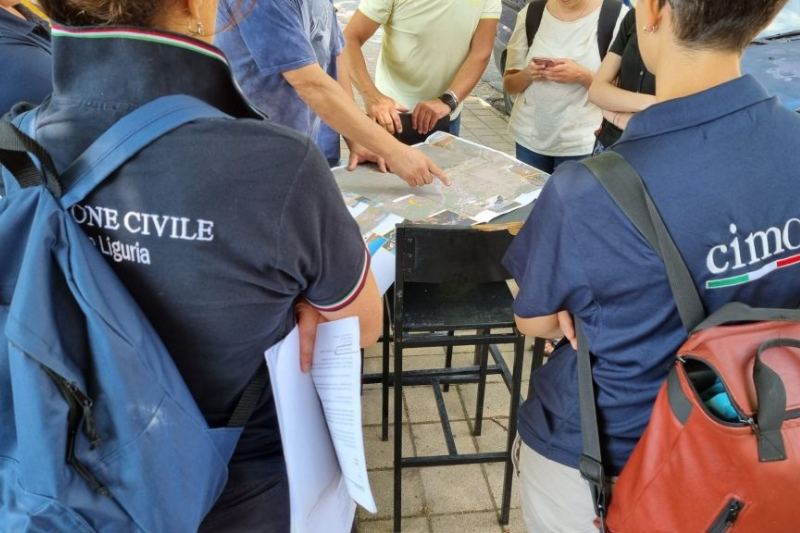
Participatory inspections organized by CIMA Foundation and the Liguria Region Civil Protection for PITEM RISK-ACT, one of the four thematic projects that are part of the PITEM RISK Integrated Plan, were held on July 6 and 7.
The meetings were held in the municipalities of the Argentina and Armea Valleys, among the locations most exposed to hydrogeological risks and climate change. The occasion allowed to listen to the voice of the citizens who live in the areas involved and who firsthand experience the critical issues, thus allowing the technicians to integrate their knowledge of the territory through the eyes of those who live it, enabling them to act in order to improve the actions provided in the local Civil Protection Plans.
PITEM RISK was created as a continuation of the RiskNat (Safe Management of Transboundary Mountain Territories) project, Alcotra Strategic Plan in which the cross-border regions of the Italian, French and Swiss Western Alps participate. They have in common not only risks, but also working experiences and knowledge related to territory.
The main objective of the Plan is the overall coordination of the four RISK PITEMs, i.e. the joint and balanced implementation of all the interventions planned by the projects that are part of it.
RISK-COM. Led by the Piemonte Region, the project aims to achieve a higher level of resilience of the Alpine arc territory with participatory guidance and information actions and concrete advancement of warning methodologies through a new cross-border warning system. The involvement of citizens, institutions and economic stakeholders in the prevention and management of risk situations is indispensable for its implementation.
RISK-GEST. The project, led by the CIMA Foundation, targets communication and coordination among the different actors in the risk management cycle: from planning and alerting through Regions/Departments, to management carried out by Metropolitan Cities/Municipalities, through intervention by the Fire Department. This also includes experimentation with participatory planning, whereby citizens become active players in the risk management system.
RISK-FOR. This is the network of training centers, educational offerings and studies for the creation of a real school of prevention, essential to familiarize oneself with the risks that insist on the territory and learn the most appropriate behavior in case of emergency.
RISK-ACT. Under the guidance of the Autonomous Region of Valle d'Aosta, it implements land and emergency management strategies by applying the products designed by RISK-COM, RISK-GEST and RISK-FOR on the territory of the cross-border area. At the same time, it tests innovative approaches in the area of communication and training.